
Table of Contents
- How to Prevent Frozen Pipes: A Step-by-Step Guide
- Step 1: Keep Consistent Heat and Seal Cold Drafts
- Step 2: How to Insulate Pipes from Freezing in Basements, Crawl Spaces, and Garages
- Step 3: Should You Let Faucets Drip to Prevent Freezing?
- Step 4: Protect Outdoor Faucets, Hose Bibs, and Garden Hoses
- Step 5: How to Prevent Pipes from Freezing During a Power Outage
- Step 6: How to Thaw Frozen Pipes Safely
- A Prioritized Checklist for Renters, Travelers, and Cold Snaps
- Frequently Asked Questions
Last Updated: October 14, 2026
How to Prevent Frozen Pipes: A Step-by-Step Guide
Frozen pipes are one of the most expensive surprises a home can throw at you. The Insurance Institute for Business & Home Safety notes that water damage from burst pipes ranks among the costliest claims homeowners file each winter. This guide from Clayton McKay walks through how to prevent frozen pipes step by step, from the first cold snap to the morning you wake up to a trickle instead of a stream.
The good news: freezing is almost always preventable. A few hours of prep in fall beats a flooded basement in January.
Frozen pipes are water supply lines whose contents have turned to ice, expanding enough to crack copper, split plastic, and push joints apart. The burst often goes unnoticed until the ice melts and water pours out. The five moves that matter most are heat, insulation, water flow, outdoor protection, and a plan for outages.
Pipes rarely freeze because it got cold. They freeze because heat was lost in one spot: a drafty rim joist, a garage wall, an unheated crawl space. Find the cold spot, and you’ve solved most of the problem.
How Cold Does It Need to Be for Pipes to Freeze?
Water pipes can freeze once outdoor temperatures drop to around 20°F, and they’re at serious risk during a sustained cold snap in the teens or lower. Wind matters too. A drafty exterior wall pulls heat out of the pipe faster than still air does.
Pipes in heated living space rarely freeze. The danger zone is anywhere the pipe sits close to outside air:
- Basements and crawl spaces with open vents
- Attics and rim joists along exterior walls
- Garages and unheated additions
So the question isn’t “how cold is it outside?” It’s “how cold is it where the pipe actually sits?”
Step 1: Keep Consistent Heat and Seal Cold Drafts
The simplest way to prevent frozen pipes is to keep indoor temperatures consistently warm day and night. Set the thermostat to at least 55°F when you leave home, and higher during a hard freeze.
Then close the gaps that let cold air reach plumbing:
- Seal cracks around pipes entering exterior walls with caulk or foam
- Weatherstrip basement windows and doors
- Close foundation vents during freezing weather
Open cabinet doors under sinks on exterior walls so warm air circulates around the pipes, especially on the coldest nights.
The most common mistake is turning the heat down to save money right before a freeze. A few dollars saved on gas can turn into a burst pipe and a flooded floor. Keep the heat on.
Step 2: How to Insulate Pipes from Freezing in Basements, Crawl Spaces, and Garages
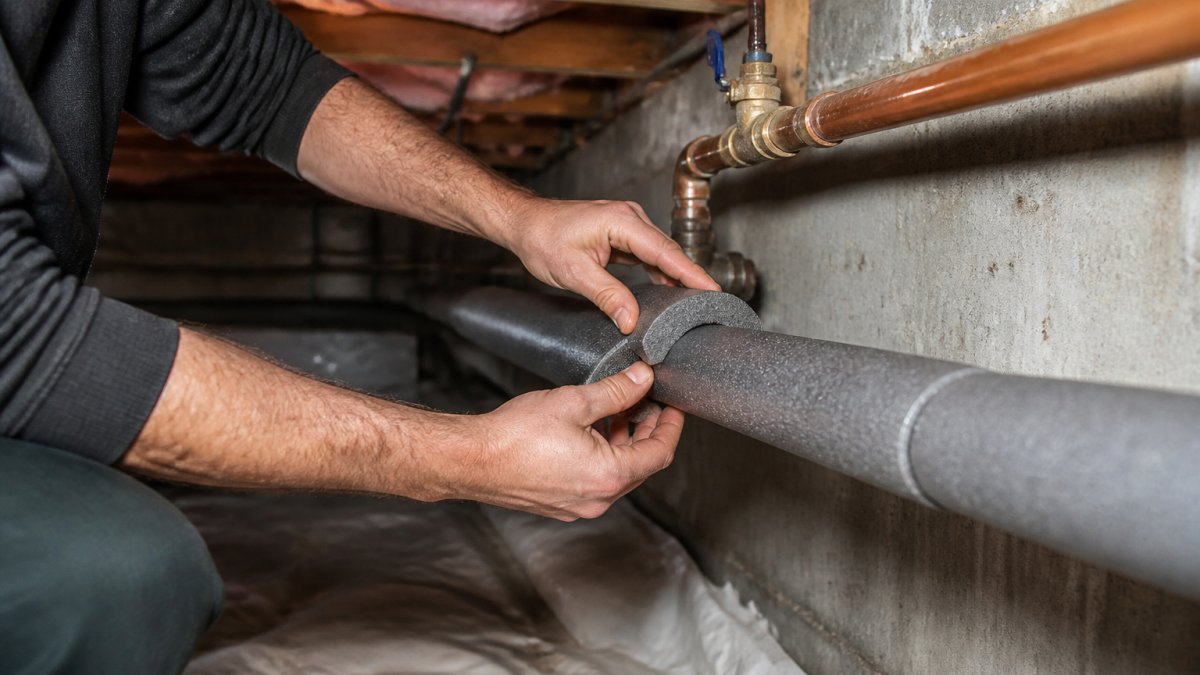
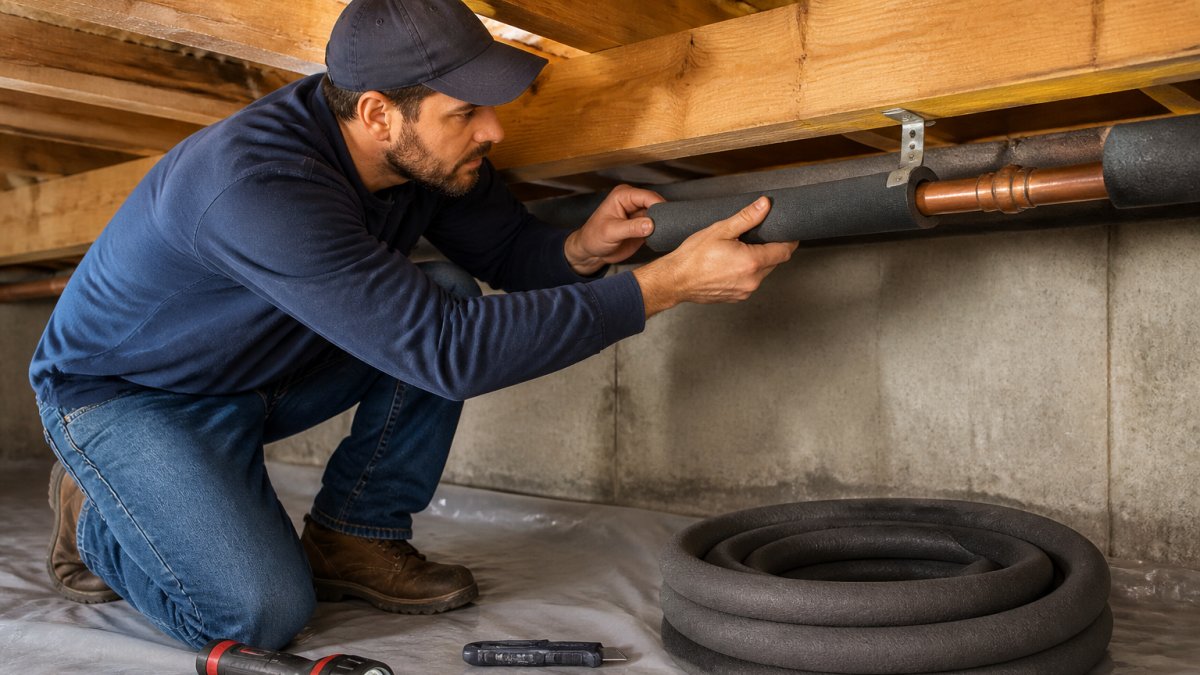
The best way to insulate pipes from freezing is to wrap them in foam pipe insulation, focusing on basements, crawl spaces, attics, and garages where pipes sit closest to outside air. Foam sleeves are cheap and easy: slide them over the pipe, seal the seams with tape, and cover every inch you can reach. In a crawl space, insulate the space itself too.
Match the Insulation to the Pipe Material
Not every pipe takes the same wrap. The wrong product can trap moisture, void a warranty, or fall off.
- Copper: Rigid foam sleeves or fiberglass wrap both work. Copper conducts cold fast, so pay extra attention to elbows, tees, and any spot where the pipe touches a joist or masonry.
- PEX: Use closed-cell foam sized for the outside diameter. PEX expands more than copper when it freezes, which is an advantage, but the fittings are the weak point, insulate them, not just the straight runs.
- CPVC and PVC supply lines: Closed-cell foam only. Fiberglass can hide cracks and makes leaks harder to spot.
Heat Tape and Heat Cable: Selection and Installation
Heat tape, also called heat cable, warms a pipe directly and is useful for a line that keeps freezing. It supplements insulation, not replaces it: the cable adds heat, the insulation holds it in.
Choosing a product:
- Buy a cable rated for water pipes and for the pipe’s material; a cable rated for metal may not be listed for plastic.
- Self-regulating cable adjusts its output as the pipe warms and is safer than constant-wattage cable, which can overheat if covered or overlapped.
- Match the length to the pipe: too long invites overlapping, too short leaves gaps.
Installing it safely:
- Never overlap the cable on itself, overlap is the most common cause of heat-tape fires.
- Never wrap a pipe that is already frozen. Thaw it first, then install.
- Run the cable in straight parallel lines or spiral it evenly, following the manufacturer’s spacing.
If you only have one heat cable to install, put it on the line that has frozen before. Past freezes are the best predictor of future ones, and the cable is most valuable where the problem is proven.
Space Heaters in Crawl Spaces and Garages
A space heater can keep a small, enclosed area above freezing, but it is the riskiest tool here.
- Use only heaters with an automatic tip-over shutoff and a thermostat.
- Keep at least three feet of clearance from anything flammable.
- Never leave one running unattended overnight or while you are away.
Which Pipes Are Most Likely to Freeze
Not all pipes freeze equally. Watch these first:
- Pipes running along exterior walls
- Supply lines in unheated basements and crawl spaces
- Pipes in attics and rim joists
If you can see the pipe and feel cold air near it, insulate it before the first hard freeze.
Step 3: Should You Let Faucets Drip to Prevent Freezing?
Yes, letting a faucet drip can prevent freezing, and it’s one of the simplest tools you have. A slow trickle keeps water moving, and moving water freezes more slowly than still water. During a hard freeze, open the faucet fed by the most exposed pipe, a pencil-thin stream is enough. The tradeoff: a dripping faucet wastes water, so insulate the pipe first and drip only on the coldest nights.
- Drip the faucet farthest from where water enters the home
- Use the cold-water side, since that’s the line at risk
- Keep cabinet doors open so warm air reaches the pipe
Step 4: Protect Outdoor Faucets, Hose Bibs, and Garden Hoses
Outdoor plumbing is the first thing to freeze and the easiest to protect. Disconnect every garden hose before the first freeze. A hose left connected traps water in the faucet and pipe behind it.
Then drain the outdoor plumbing:
- Shut off the valve feeding outdoor faucets, if you have one
- Open the hose bib to drain remaining water
- Install an insulated cover over each hose bib
A frost-proof hose bib helps, but only if the hose is off. Leave it connected and the pipe behind the wall can still split.
Step 5: How to Prevent Pipes from Freezing During a Power Outage
When the heat goes out, the clock starts. A house at 68°F can drop into the 40s within a few hours in a hard freeze, and pipes in exterior walls, crawl spaces, and garages get there first. The goal is to slow that drop and keep water moving until power returns.
The First Two Hours
- Close every exterior door and window, and shut the damper on any unused fireplace.
- Pick one or two rooms to occupy and close the rest off; a smaller heated volume holds warmth longer.
- Open cabinet doors under sinks on exterior walls so room air reaches the pipes.
If the Outage Stretches Past a Few Hours
Watch the indoor temperature. Treat 55°F as the floor: once the house approaches that number and no restoration is forecast, stop trying to keep the whole system live and start protecting it.
- Locate the main water shutoff valve if you have not already. Every adult in the house should know where it is and how to turn it.
- Shut off the main valve.
- Open every faucet, hot and cold, top floor first, to drain the lines and relieve pressure.
- Flush toilets once to empty the tanks, then pour a little nontoxic RV antifreeze into each bowl and tank if you expect a long freeze. Never use automotive antifreeze indoors.
- Drain the water heater if you can do so safely, following the manufacturer’s instructions.
A dry pipe cannot burst: if there is no water in the line, expanding ice has nothing to push against.
If You Have a Backup Heat Source
- A wood stove or fireplace can keep one room livable, but it will not protect pipes in a distant crawl space.
- A portable generator can run a space heater or furnace blower only if sized for the load and plugged into a transfer switch or run with properly rated cords. Never backfeed a house through a dryer outlet.
- A natural-gas or propane fireplace that vents outdoors is safe to run; a vent-free unit produces moisture and carbon monoxide and should be used sparingly.
When Power Comes Back
Do not just flip the breaker and walk away. Restore heat first, then water.
- Turn the thermostat back to normal and let the house warm for at least an hour.
- Check every faucet for flow. A trickle where there used to be a stream means a line is still frozen or already split.
- Look for water stains on ceilings, walls, and floors near exterior walls and under sinks.
- If the main valve was shut off, reopen it slowly and watch for leaks at every fixture.
- If you drained the water heater, refill it before restoring power to the element, a dry element burns out in seconds.
If you left the house during an outage and returned to find it below freezing, do not turn the heat on full blast. Warm the house gradually. A fast temperature swing stresses already-frozen joints and can turn a hairline crack into a flood.
Keep a winter outage kit where you can find it in the dark: a flashlight, spare batteries, a wrench sized for your main valve, a few gallons of drinking water, and a printed list of your utility’s outage number and a licensed plumber’s after-hours line.
Step 6: How to Thaw Frozen Pipes Safely
If a pipe has already frozen, thaw it slowly and gently. The goal is to melt the ice without cracking the pipe or starting a fire. Open the nearest faucet so melting water has somewhere to go, then warm the pipe with a hair dryer, heat lamp, or warm towels, working from the faucet end back toward the frozen spot.
Watch for these warning signs that a pipe has burst:
- A faucet that gives no water or only a trickle
- Hissing or banging inside a wall
- A bulge or crack in the pipe
If you see water, shut off the main water valve first, then call a licensed plumber.
If you can’t find the frozen spot, or the pipe is inside a wall, stop and call a professional. Poking around a wall or using a torch is how small problems become big ones.
A Prioritized Checklist for Renters, Travelers, and Cold Snaps
Use this checklist to prevent frozen pipes based on your situation and the temperature outside.
| Situation | Priority Action | Timing |
|---|---|---|
| Heading to work | Keep heat at 55°F or higher | Before you leave |
| Leaving for days | Shut off main valve, drain lines | Before you go |
| Hard freeze tonight | Drip exposed faucets, open cabinets | Evening before |
| Renters | Report cold drafts to landlord | Before first freeze |
| Power outage | Drip faucets, shut off if heat fails | Immediately |
| Already frozen | Thaw slowly, never use flame | Right away |
Renters can drip faucets and report drafts, but insulation and repairs are often the building owner’s job. Put requests in writing so there’s a record.
If prevention has failed and you’re facing a burst pipe, Clayton McKay has served Plymouth, the South Shore, and Cape Cod since 1973 with licensed plumbers, electricians, and certified HVAC technicians.
Frequently Asked Questions
At what temperature will pipes freeze?
Water pipes are most at risk when outdoor temperatures drop to 20°F or below, though exposed pipes in unheated spaces can freeze sooner. The temperature inside your walls and crawl spaces matters more than the outdoor reading. Keep indoor temperatures at 55°F or higher, even when you are away, and pay attention to pipes running along exterior walls, in attics, and in garages during any cold snap.
Should you let faucets drip to prevent freezing?
Yes, letting a faucet drip during freezing temperatures helps prevent frozen pipes. A slow trickle keeps water moving through the pipe, which makes it harder for ice to form and gives expanding ice a place to escape. Choose the faucet farthest from your main water valve, and use cold water since hot water can waste energy. The tradeoff is a slightly higher water bill, but it is far cheaper than repairing a burst pipe.
How do you prevent pipes from freezing during a power outage?
When the power goes out, your furnace stops running and indoor temperatures fall fast. Shut off your main water valve and drain the system by opening every faucet, starting with the highest floor. Open cabinet doors under sinks to expose pipes to whatever warmth remains. If you stay in the home, use a safe alternative heat source and let faucets drip. If you leave, draining the system is the most reliable protection against frozen pipes.
What should you do if you think a pipe is frozen?
Turn on the nearest faucet and check for a trickle or no flow at all. If you suspect a frozen pipe, keep the faucet open and apply gentle heat using a hair dryer, heating pad, or towels soaked in warm water. Start near the faucet and work toward the coldest section. Never use an open flame or propane torch. If you cannot find the frozen section, or if you see bulging or cracks, shut off the main water valve and call a licensed plumber.
A frozen pipe is a race against the thermometer, and the prep work that saves you happens before the first cold night. If you’d rather hand the worry to someone else, Clayton McKay offers a single trusted source for plumbing, heating, cooling, and electrical needs across the region. Our licensed team brings priority scheduling, preventative maintenance, and honest pricing to every call. Get an instant quote from Clayton McKay and keep your home dry all winter.

Leave A Comment