

Last Updated: November 5, 2026
Quick Summary
Signs you need an electrical panel upgrade include breakers that trip repeatedly in the same spot, a panel that feels warm to the touch, lights that dim when appliances kick on, buzzing or crackling sounds, and no open breaker slots. A fuse box, rust or corrosion inside the enclosure, or a service rating below what your home needs also point to replacement.
- Never swap a tripping breaker for a bigger one, because the breaker is sized to protect the wire.
- A fish-like odor near an outlet or panel means melting insulation: shut off power, leave, and call for help.
- An inspection includes a thermal check, torque check on terminals, load calculation, and grounding review.
- A load calculation adds up appliance wattage and compares it to your service capacity before you buy.
- A clear quote separates the panel and breakers, labor, permit fees, utility coordination, and wiring remediation.
Table of Contents
- Signs of an Overloaded Electrical Panel
- When Your Circuit Breaker Keeps Tripping
- Flickering Lights, Warm Outlets, and Burning Smells
- Outdated Panels, Fuse Boxes, and Expected Service Life
- Adding Major Appliances and Running Out of Breaker Slots
- What an Electrical Panel Inspection Covers
- Electrical Panel Upgrade Cost: What Drives the Price
- Book Your Electrical Panel Inspection with Clayton McKay
- Frequently Asked Questions
Signs of an Overloaded Electrical Panel
An overloaded electrical panel is a breaker box pushed past the amount of power it was built to carry. When that happens, the panel can’t distribute electricity safely, and it starts telling you so through heat, sound, and repeated shutdowns.
Most homeowners ignore the early warnings because the lights still come on. The U.S. Fire Administration’s electrical fire safety guidance points out that electrical failures remain a leading cause of home fires, and overloaded panels sit near the top of that list.
Here’s how to tell whether your panel is simply busy or genuinely overloaded:
- Breakers trip in the same spot over and over. One tripping breaker is annoying. The same breaker tripping every week is a message.
- The panel feels warm to the touch. A panel should be cool. Warmth means resistance, and resistance means heat.
- Lights dim when appliances kick on. Your HVAC system or dryer shouldn’t make the kitchen lights stutter.
- You hear buzzing or crackling. Any sound from inside the panel is a stop-what-you’re-doing signal.
That habit doesn’t fix an overloaded panel. It just delays the day it fails.
When Your Circuit Breaker Keeps Tripping
A circuit breaker that keeps tripping is doing its job: it’s cutting power before a wire overheats. The question isn’t why it trips.
Start simple: unplug what’s on that circuit and reset the breaker. If it holds with nothing plugged in, the problem is the load, not the wiring.
Common culprits:
- Space heaters and window AC units sharing one circuit
- Kitchen circuits running a microwave, toaster, and coffee maker at once
- Power strips daisy-chained into other power strips
- Extension cords used as permanent wiring
- Old circuits feeding modern appliances they were never sized for
Watch out: never swap a tripping breaker for a bigger one. That’s the most dangerous shortcut in home electrical work.
If your breaker keeps tripping, the U.S. Consumer Product Safety Commission’s electrical safety resources are worth a read before you decide to live with it. For a plain-language walkthrough of why it happens, see our guide on why your circuit breaker keeps tripping.
Flickering Lights, Warm Outlets, and Burning Smells
Flickering lights, warm outlets, and burning smells are three warnings you should never sit on. Each points to heat or arcing somewhere in the system, and heat is what starts fires.
Here’s the difference that matters:
| Warning Sign | What It Usually Means | How Urgent |
|---|---|---|
| Lights dim when appliances start | Load shifting, possibly undersized service | Schedule an inspection |
| Lights flicker constantly | Loose connection or failing breaker | Call within days |
| Outlet faceplate warm to touch | Overloaded circuit or bad connection | Call now |
| Faint burning smell, no smoke | Overheating wire or breaker | Call now |
| Fish-like odor | Melting insulation or plastic | Evacuate and call |
| Scorch marks or soot on panel | Arcing or a failed breaker | Evacuate and call |
A warm outlet is not normal. Neither is a panel that smells like hot plastic.
Buzzing or crackling from the panel is the same story: arcing makes noise, and arcing is how electrical fires begin. If you’re noticing these signs alongside other issues, our article on signs of faulty electrical wiring covers what to check next.
Outdated Panels, Fuse Boxes, and Expected Service Life
An outdated panel can’t meet modern demand or current safety standards.
Panel service life depends on conditions such as heat, moisture, and repeated overloads, which can shorten it. An older panel is worth a professional look, regardless of how it’s behaving.
Signs your panel has aged out:
- A fuse box instead of breakers. Fuses work, but they’re limited and often improperly “fixed” with pennies or oversized fuses.
- Brands with known failure records. Certain older panel brands have documented safety problems. A licensed electrician can tell you if yours is one.
- Rust, corrosion, or pest damage inside the enclosure.
- No room to grow. A panel with zero open slots has hit its ceiling.
- A service rating below what your home needs. Many older homes were built with 60-amp or 100-amp service.
If you’re wondering whether yours is simply old or due for replacement, how long a home electrical panel usually lasts answers the lifespan question directly.
Adding Major Appliances and Running Out of Breaker Slots
The usual suspects:
- Electric vehicle chargers, which draw heavily and run for hours
- Heat pumps and central HVAC systems
- Electric ranges, ovens, and induction cooktops
- Tankless water heaters
- Hot tubs and pool equipment
Before you buy, do the math. A load calculation adds up the wattage of everything in the home and compares it to your service capacity.
Running out of breaker slots is the visible version of this problem.
If you’re planning a new appliance and aren’t sure what your home can handle, what size electrical service your home needs breaks down the capacity question.
What an Electrical Panel Inspection Covers
An electrical panel inspection is an assessment of your service panel, its connections, and the circuits it feeds. The goal is to determine whether your panel is safe and whether it has capacity for current and planned loads.
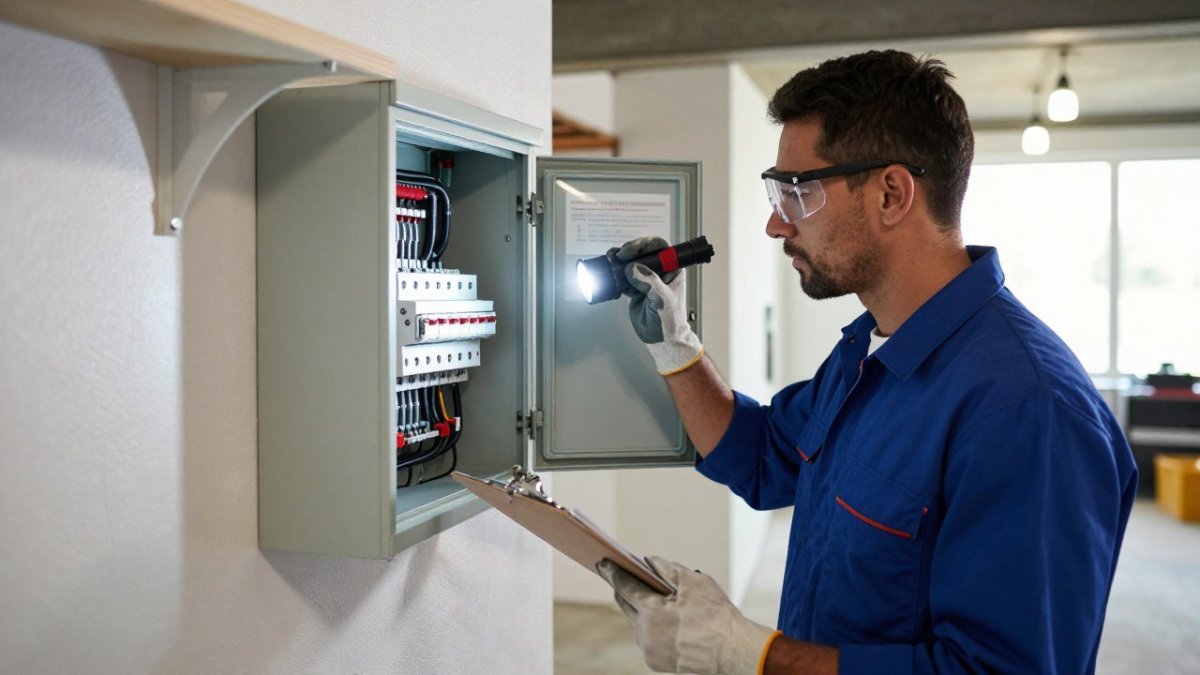
What the electrician actually does
A thorough inspection follows a sequence, and the order matters because each step informs the next:
- Visual exam of the panel interior. The electrician removes the cover and looks for scorch marks, corrosion, loose breakers, double-tapped connections, and pest or water damage, and identifies the panel brand and model to check for known failure records.
- Thermal check. An infrared thermometer or thermal camera finds hot spots invisible to the eye; warm terminals or breakers indicate resistance, which precedes failure.
- Torque check on main lugs and breaker terminals. Loose connections cause most panel fires, so the electrician verifies terminals are tightened to the manufacturer’s specified torque.
- Load calculation. The electrician adds up the wattage of everything in the home, including major appliances, HVAC, and planned additions such as an EV charger, and compares the total to your service rating.
- Grounding and bonding review. The panel must be properly grounded and bonded to the water and gas piping per current code; poor grounding is a shock and fire hazard that doesn’t show up as a tripped breaker.
- Circuit mapping. The electrician labels what each breaker actually controls, mislabeled panels are common and make future work slower and less safe.
- Code review. Anything that no longer meets current requirements is flagged, including missing AFCI or GFCI protection, undersized wiring, and improper breaker types.
What happens after the inspection
If the inspection finds only minor issues, the electrician may recommend targeted repairs such as replacing a failed breaker or tightening connections.
Watch out: never remove the panel cover yourself to “take a look.” The main lugs remain energized even with the main breaker off, and the interior contains live components that can cause serious injury.
If you are weighing whether your panel is simply old or actually due for replacement, how long a home electrical panel usually lasts answers the lifespan question directly.
Electrical Panel Upgrade Cost: What Drives the Price
Electrical panel upgrade cost depends on the scope of work, not a flat rate. Two homes on the same street can get very different quotes because the panel is only part of the job. Separate the panel itself from the service work around it, because the second part is usually where the range widens.
The main cost drivers
- Service size. Moving from 100 amps to 200 amps is a bigger job than swapping a same-size panel. A same-size replacement involves the panel, breakers, and labor to transfer circuits; a service upgrade adds a new meter base, new service entrance conductors, and often a new grounding electrode system.
- Panel type and brand. Some panels are straightforward swaps. Others, particularly older panels with known failure records or discontinued breaker lines, require more labor and sometimes a larger enclosure to fit modern breakers.
- Wiring condition. Old wiring may need remediation before a new panel can be installed safely. Aluminum branch wiring, cloth-insulated wiring, and undersized conductors are common in older homes, and each adds scope.
- Permits and inspection fees. These vary by jurisdiction and are part of the real cost.
- Utility coordination. A service upgrade may require the utility to disconnect and reconnect power, and some utilities charge a fee for the disconnect or require a new meter. This is also a scheduling cost, because the project cannot be completed until the utility reconnects.
How to read a quote
A clear quote separates the panel and breakers, labor, permit fees, utility coordination, and any wiring remediation. If a quote is a single number with no breakdown, ask for the breakdown before comparing it to another. The lowest number is not always the lowest cost, because a quote that omits permit fees or wiring remediation will grow once the work starts.
Pricing depends on your specific panel, service size, and wiring condition, so an inspection is the right starting point for an accurate quote.
Book Your Electrical Panel Inspection with Clayton McKay
Repeated breaker trips, warm outlets, a buzzing panel, or a fuse box that’s outlived its era: these are the signs you need an electrical panel upgrade, and they won’t resolve on their own.
Clayton McKay is a family-owned home services provider serving Plymouth, the South Shore, and Cape Cod since 1973.
If you’re ready to stop resetting that breaker and get a straight answer, book your electrical panel inspection with our team.
Frequently Asked Questions
How do I know if my electrical panel needs to be upgraded?
Look for repeated breaker trips, flickering or dimming lights, a warm panel or outlets, burning or fish-like odors, scorch marks, and an outdated fuse box or panel with no available breaker slots. Any one of these warrants an electrical panel inspection by a licensed electrician. If your panel is undersized for your power demand or you plan to add an EV charger or HVAC system, a service upgrade may be the safer long-term choice.
What is the 80% rule for electrical panels?
The 80% rule means a circuit should carry no more than 80% of its rated amperage for continuous loads. A 100-amp panel, for example, should not sustain more than 80 amps of continuous draw. Exceeding that margin causes frequent tripping, heat buildup, and premature wear. An electrician can run a load calculation to confirm whether your panel capacity matches your home’s actual electrical load before you add major appliances.
Can I upgrade my electrical panel without rewiring my house?
Often yes. A panel replacement or service upgrade can be done without touching the branch wiring if the existing circuits are in good condition and code-compliant. During the electrical panel inspection, the electrician checks wire condition, grounding, and bonding. If the wiring is degraded or lacks a proper ground, partial rewiring may be required. The inspection report should separate what is mandatory from what is optional.
Can a new electrical panel support an EV charger or other major appliance?
A new panel gives you the capacity and available breaker slots an EV charger, heat pump, or electric range needs. A 200-amp service is the common baseline for homes adding an electric vehicle charger alongside existing HVAC and appliance loads. A load calculation can show whether a panel replacement alone is enough or whether a full service upgrade is required.
Your panel has been telling you something for a while now. Let Clayton McKay’s licensed electricians take a look, give you an honest assessment, and handle the upgrade with the clear communication and precise scheduling you deserve. Get started with Clayton McKay and put your home’s electrical system on solid footing.




Leave A Comment